Demands on educators are soaring, their time increasingly stretched thin. In this hurricane of responsibilities, one of the most time-consuming tasks they grapple with is designing lesson plans.
But what if we could leverage technology to lighten this load?
Enter Artificial Intelligence – not as a techy terminator of jobs, but as an ally in education. No longer are we asking ‘if’ AI will reshape pedagogy; the question now is ‘how.’ This shift marks the dawn of a practical, down-to-earth era in education where AI becomes a valuable assistant, freeing up educators to invest more time in what truly matters – teaching.
A Sneak Peek into AI’s Influence on Lesson Planning
Step into your next lesson planning session with an AI-backed system and observe how it transforms the very pillars of lesson design. This goes beyond mere efficiencies; it touches the core essence of educational experience.
Let’s say you’re laying the groundwork for a lesson. Conventionally, you’d begin with setting the objectives. Now, with AI at your disposal, it’s like having a seasoned educator at your elbow, suggesting clear, student-focused objectives based on set standards.
Then there’s the hustle of resource curation – textbooks, articles, videos. With AI, the browser simply to your preferences. It filters out irrelevant noise, spotlighting resources that truly enrich your students’ learning experience.
Moving on to the creative part – designing engaging activities. Traditionally, educators might spend hours scouring the internet for new activity ideas. With AI, you get a treasure trove of diverse, vetted ideas at your fingertips.
Assessment creation and scoring, notoriously time-consuming, now become effortless. Algorithms powering the AI can draft a variety of question types – simple to complex – enabling comprehensive evaluation of students’ grasp over the subject.
Finally, differentiation, that tricky balance between catering to all learners without overwhelming any one, becomes a simplified task. AI can model student profiles and suggest differentiated instructional strategies – letting you tailor your teaching approach to each learner’s needs.
There you have it – AI, a virtuoso conductor orchestrating symphonies of seamless, student-centric learning journeys. In the following sections, we’ll delve deeper into the ‘how’.
Planning Lessons with Assistance from AI: A Practical Guide
Boost your lesson planning process by integrating an AI-enabled platform. This is not about replacing your role as an educator, but enhancing it with intelligent suggestions. Here’s a roadmap to start using AI in your planning:
1. Rooting in Objectives: Begin with AI as your brainstorming partner, helping to crystallize learning objectives based on set standards. This removes guesswork, trimming your efforts and time.
2. Harnessing Resources: AI aids in the tiresome task of content curation. It sifts through resources, pulling out engaging articles, videos, and interactive materials aligned to your lesson goals.
3. Activities, Simplified: Ready to move beyond mundane? AI handpicks a variety of activity ideas for you, encouraging critical thinking and engagement among students.
4. Accommodating All: No more bending over backward to cater to everyone’s learning style; AI can customize content and activities for different learners, making differentiation a snap.
5. Assessments – Automated and Accurate: AI streamlines the process of designing quizzes and rubrics, all while ensuring a comprehensive coverage of your lesson plans.
This AI-guided approach to lesson planning saves significant effort and time, yet delivers a better educational experience. Surely, the age-old adage holds true – sometimes, the best help comes in the form of a good tool, just like AI.
A Selection of AI Aids for Lesson Planning
Who wouldn’t appreciate an extra-assistant at hand while lesson planning? Especially one that’s available around the clock and requires no coffee breaks. AI tools can serve as your tireless collaborators in the adventurous journey of teaching, playing roles from resource curators to activity idea generators.
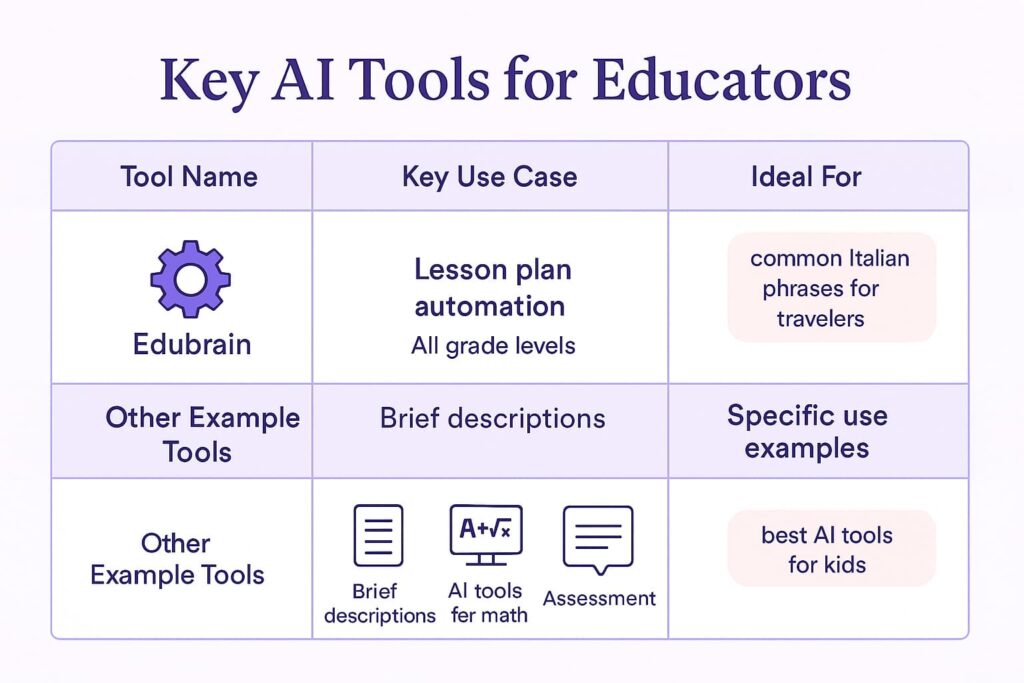
- Picture this: you’re brushing up on your geography lesson plan, yet feel it lacks an enriching cultural aspect. Find AI tools, your AI-powered companions. With only a prompt, it generates a list of common Italian phrases for travelers, instantly lending depth to your lesson.
- Hit a roadblock while thinking up new fun ways to engage your students in mathematics? Worry not, as there exist specially-crafted AI tools for math teachers. These aid in devising interactive exercises, challenging puzzles, and engaging quizzes that make numbers fun.
- Look no further for a child-friendly educational tool. Best AI tools for kids fuse learning with play, instigating curiosity, and fostering understanding. They adapt to the child’s learning pace and style, making education a tailored, enjoyable experience.
- Want to try your hand at scripting educational games or interactive quizzes? An array of AI platforms for content creation exists, easing the process of curriculum design and transforming lesson delivery.
- If personalizing each student’s learning experience sounds demanding, rely on AI tools for differentiated instruction. They analyze student data, predicting learning needs and suggesting individualized teaching strategies.
So, whether you’re crafting content on Shakespeare’s plays or constructing challenging algebraic concepts, you’ll find an AI tool ready to assist. The future of education is here, and it starts with an AI tool for lesson planning.
Cutting the Double Edged Sword: The Gains and Pains of AI in Lesson Planning
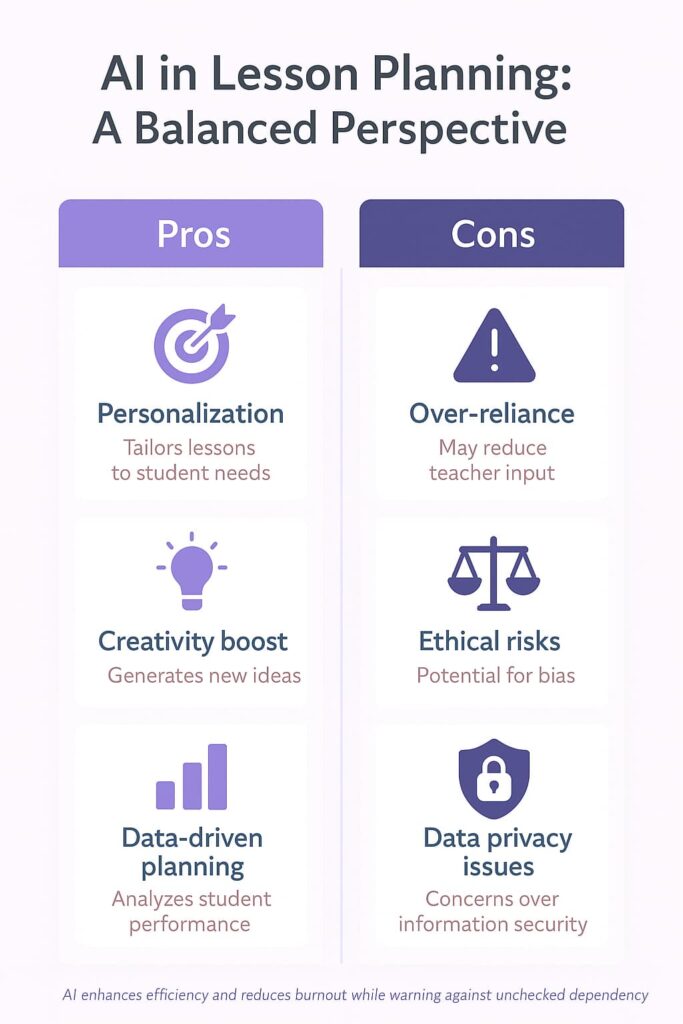
Let’s be real, AI provides a multiple of benefits for lesson planning. For starters, it ushers in an era of enhanced personalization. Ever had a student fall behind because they couldn’t quite grasp a concept? AI can identify the learning gaps and tailor the content to fit the student’s needs.
On top of that, it fosters creativity among educators. By taking over mundane tasks, teachers have more time to design innovative lesson plans. One last pro, but certainly not the least, is the data-driven insights from AI. From analyzing student performance, educators can further refine future lesson plans.
But as they say, every rose has its thorns. The same goes for AI in lesson planning. One major drawback is the potential over-reliance on technology. AI is simply a tool and not a substitute for human oversight. When technology fails, teachers must step up.
Alongside that is the black box problem, where AI’s logic remains a mystery. Lastly, data privacy concerns are valid points, given the sensitive nature of the information AI processes.
Striking a balance between AI’s use and human responsibility should remain a priority for everyone. After all, we aim to educate and protect our students simultaneously.
The Unwavering Value of Human Touch in Teaching
While AI exceeds in performing data-driven tasks, it remains distant in certain crucial zones. Let’s talk about some of those.
For one, it falls short in exhibiting empathy—the ability to truly understand the joys and frustrations of your students’ educational journey. Then there’s the essential skill of critical judgment. A machine may churn out impressive data analysis, but it lacks the human intuition to interpret and act wisely upon that information under unique circumstances.
Furthermore, artificial intelligence holds no badge of authority in classroom management. Taming a bunch of energized pre-teens on a sunny Friday afternoon? That’s your territory, not AI’s. Building nurturing bonds with students is something machines simply can’t replicate. Either is adapting to real-time dynamics of a lively classroom, where change is the only constant.
So, dear educators, rest assured that your role remains irreplaceable even in the face of advancing technology. It’s because you were, are and always will be more than just ‘knowledge dispensers’. You are counselors, motivators, mentors, roles no AI can assume. Your professional expertise combined with AI tools can lead to fertile grounds for learning, where digital innovation meets the timeless wisdom of human educators.
Classroom of Tomorrow: Initiating AI Adoption
Ready to infuse your classroom with AI’s transformative power? Here comes a practical checklist to set you off in the right direction.
- Begin at the Ground Level: Choose one or two AI tools and experiment for a specific task.
- Cultivate Your Understanding: Broaden your horizon by seeking training opportunities on AI in education.
- Harvest Success with Others: Foster a learning community by sharing your experiences with fellow educators.
- Keep the Learning Wheel Turning: Stay in tune with latest AI advancements to remain ahead of the curve.
- Ethics, A Not-to-ignore Aspect: Keep reminding yourself about the importance of fairness and bias while using AI.
With these steps, you can navigate your way through the AI integration journey, always focusing on the student’s benefit at the end of the day.
A New Dawn in Educational Evolution
Embracing AI is more like freeing up your teaching prowess, not taming it. It represents an immense leap in the way education is structured, with the potential to make lesson planning more efficient, personalized, and engaging.
Picture yourself collaborating with an intelligent partner, tuned to your unique teaching style, easing the continual tug-of-war between lesson logistics and actual teaching. And it’s only the beginning.
The footprint of AI in education will continue to stretch, igniting novel strategies for achieving educational excellence. Instead of sitting on the sidelines, join the forefront of this educational evolution. Explore AI tools, experiment, refine and reiterate.
After all, pioneering change is a quintessential hallmark of being an educator.