For most, the dawn of Artificial Intelligence evokes imagery of complex coding and high-tech programming. Yet, if we’re to adequately arm our kids with essential skills for the future, it becomes crucial to dispel this simplistic perception. Teaching AI is far from monotone coding— it is comprehensive.
The key lies not only in understanding the language of AI but also in comprehending its ethical implications. AI education for our kids should pave their way to navigate through the world of tomorrow competently, and it demands a unique approach, one that dives deeper than the surface-level intricacies of coding.
AI Demystified: Child-Sized Ways to Grasp Big Concepts
Artificial Intelligence. A phrase that rings with the promise of tomorrow, yet often skews complex and grown-up. Let’s jettison the highbrow jargon and break it down into bits that kids can genuinely connect with.
Think of AI as a clever friend who remembers, learns, and decides things. It’s a lot like playing ‘I spy’ where you recognize patterns. AI is the savant player who can pick out not only colors and shapes but also complex patterns like human speech or your favorite music!
Understanding ‘Data’ is like handling LEGO bricks. The more blocks you have, the more magnificent fortresses, spaceships, or unicorns you can build! In AI, data are these blocks. They feed AI, aiding it to make smart decisions.
Arming kids with these tangible analogies provides a relatable entry point to AI and fosters a deeper curiosity about the world of technology they’ll grow up into. And isn’t instilling curiosity the heart of any learning?
AI Misconceptions and Truths: A Child-Friendly Guide
Let’s make a fun game out of AI! In this game, we separate fact from fiction, clearing some of the fog that surrounds Artificial Intelligence. For starters, kids, let’s take the notion that ‘AI never makes mistakes!’ Guess what? That’s a myth. Fact- AI won’t ace all its tasks unless it wades through the right data. Just like you learn and improve your homework performance by going through heaps of practice sets.
Another fairytale is, ‘Robots with AI will rule the world!’ This scares even adults! And the truth here? Robots might be smart, but ultimately, they are tools we use intelligently. They’re like Power Rangers action figures – they may look cool and do a lot of things, but in the end, you still control them.
Aha! Two myths busted already. Isn’t this better than believing in fictional tales that often confuse the picture of AI? This way, you can see AI for what it really is, helping you grow into responsible users of technology.
Concrete AI Encounters: Activities to Stir Inquisitive Minds
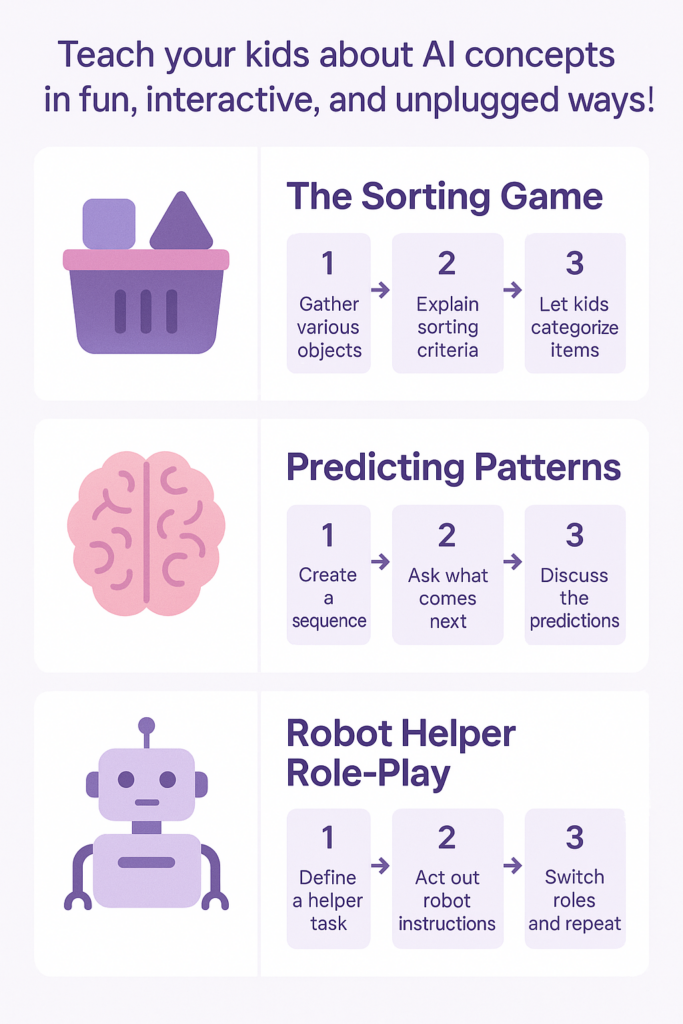
Ever thought about shaping AI concepts into hands-on experiences for your children? Let’s dive straight into tangible activities, eschewing screens and inviting curiosity. Firstly, consider ‘The Sorting Game’. This activity transforms the abstract idea of data classification into a kinetic experience. Just spread out a deck of playing cards and encourage your kids to sort them by suit, rank, or color. Observe how they strategize, hinting at how AI organizes vast amounts of data.
Our second activity introduces machine learning basics playfully: ‘Predicting Patterns’. Here, you can make simple sequences using objects or pictures and challenge your kids to guess what comes next. This mirrors how AI predicts outcomes based on recurring patterns.
Lastly, we have ‘Robot Helper Role-Play’, marking an adventurous journey into automation and ethics. Imagine and enact scenarios where automated helpers make choices. What if the robot vacuum cleaner could decide which room to clean first? How would it weigh its choices? This exercise facilitates discussions on decision-making and ethical quandaries tied to AI.
Armed with these unplugged activities, children get more than just a glimpse of AI; they get an engaging, enjoyable encounter that fosters understanding and critical thinking.
Guide to AI Ethics for Young Minds: Building Thoughtful Digital Natives
Ethics and AI have an intertwined relationship, one that shouldn’t be forgotten when teaching our children about AI. If we want to raise a generation of responsible digital citizens, we must introduce themes of bias, privacy, and the impact of AI on society, translating them into a language our little learners can grasp.
To start, a simple discussion about favorite toys or cartoons can be the gateway to the conversation on bias. Ask questions like, ‘Why does your superhero toy only come in certain colors or types?’ or ‘Why does one animal always win in that cartoon?’ to initiate discussions about bias. This can be a soft introduction to the concept of how data bias influences AI.
Privacy in this digital era is a critical topic that’s pertinent to even our youngest tech users. A good way of teaching this is through ‘The Secret Code Game’. Create a simple code with your children, something secret that only both of you can understand. This experience impresses upon them that some information should remain private and is not for sharing, much like with AI.
Taking about the societal impact of AI may seem overwhelming for children, but remember, they’re more insightful than we often give them credit for. Suggest scenarios such as ‘What if a robot could serve lunch in school, and the human cook lost their job?’ Stimulate their minds about the potential upside, like speedy service, but also the downside, such as job loss.
The objective here is not to make our children passive consumers of AI but to nurture them into thinkers. It’s about making them question and understand how AI is affecting their world, keeping curiosity aflame, and ethics at the forefront.
Sparks fly: AI Chat at Home
Stimulating conversations about AI don’t need to confine themselves to classroom walls. Why not ignite them at home during a meal or bedtime routine? Keep things casual, lighthearted yet pensive with these open-ended questions.
- “Can you give me an example of AI being a good buddy to someone?” This question urges kids to reflect on the supportive side of AI, maybe a speech recognition app helping a visually impaired person.
- “How do you reckon AI gets brainy?” This inquiry encourages children to think about the learning routes an AI might tread.
- “Who do you think is the coach for an AI, deciding what it learns?” This prompts them to consider the role humans play in shaping an AI’s learning.
- “What would happen if your music playlist was decided by AI?” This question, though seemingly innocent, can start conversations about data privacy.
These questions aren’t hard and fast rules but simple jump-off points to engage your bright young minds in meaningful dialogue about AI. Remember, the goal isn’t immediate answers; it’s curiosity with purpose.
Digital Platforms for Age-Appropriate AI Exploration
Let’s talk about screens. Yes, they do have an important role in teaching AI concepts to children, but it’s not about who gets the shiniest tablet first; it’s about leveraging the right digital tools at the right time. The key is to use these platforms to complement foundational AI learning, not to dictate it. So, calm the urge to tech-it-all-up and take a measured approach.
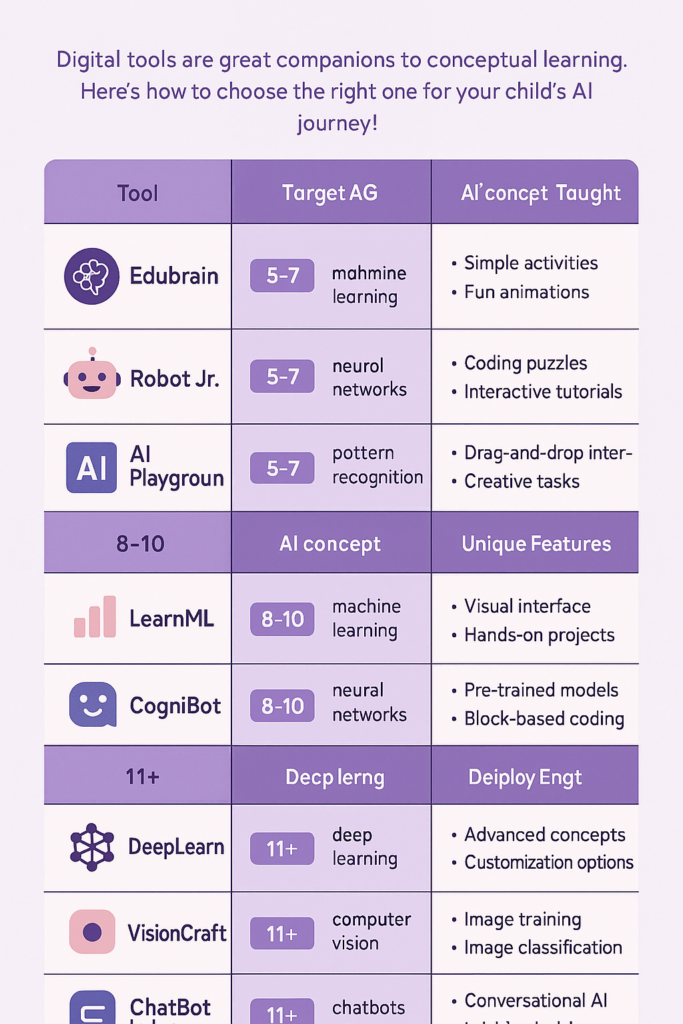
Introducing AI explorer platforms in early primary grades can be a great starting point. These platforms offer playful, user-friendly interfaces that allow children to grapple with basic AI concepts through engaging activities.
As the children get comfortable with simple AI tasks, you can graduate to more advanced platforms. Edubrain, a valuable resource breaking down complex AI topics into modules suitable for older children, is worth a mention here. It supports guided exploration of AI, fostering a hands-on approach to learning.
It’s not about serving as some all-knowing ‘AI homework helper’ but instead it assists children to learn AI by dissecting real-life scenarios, making their AI education more practically relatable.
The right blend of digital tools at the right stage of learning can bolster a child’s understanding of AI; it’s all about finding a balanced formula for your young learner. Remind yourself that technology is a facilitator, not a teacher; it should not overshadow the elemental aspects of AI education.
Navigating the AI Landscape: A Parent’s Checklist
Initiating AI discussions at home and selecting the right platforms for your child’s AI exploration can be meaningful first steps. However, the journey doesn’t stop there. Let’s map out your child’s AI learning journey together with this handy checklist:
1. Partner in their learning. Dive headfirst into the subject, learn alongside them. That way, your enthusiasm for the subject will rub off on them.
2. Cultivate a habit of questioning. Encourage your child not just to seek answers, but most importantly, to ask the right questions.
3. Inspire AI creativity. Spark your child’s imagination in using AI for creation, rather than just passive consumption.
4. Foster an ethics-first attitude. Make room for discussions that concern ethical implications of AI usage, building a foundation for responsible AI interaction.
5. Maintain a healthy balance. While digital platforms are useful, balance this with hands-on ‘unplugged’ activities to foster a well-rounded understanding of AI.
This checklist isn’t a recipe for instant success, rather a compass guiding you through the labyrinth of AI education for children. The goal isn’t a to-do list, but a nudge towards fostering curiosity, ethical awareness, and a balanced learning environment. With these pointers in mind, prepare to embark on a fascinating journey through the world of AI with your child.
Three Pillars of Ethical AI Education
Enhancing technological literacy isn’t merely about mastering a new language; it’s also about shaping an innovative, ethical, and critical mindset. Teaching AI to children thus extends beyond making them adept with machine commands. It’s about nurturing their imaginative potential, guiding them to ask pertinent questions and contemplate ethical implications before jumping to results.
Remember, introducing children to AI should aim for balance, preserving creativity while fostering a computational mindset. AI education should not merely turn children into proficient users but aim to raise insightful thinkers and informed innovators.
The Takeaway: Turning Children into Thoughtful AI Innovators
In your hands lies an extraordinary power: steering the future. With thoughtful AI lessons, we can ensure our children are not mere robots, but creators and critical thinkers for an AI-influenced world. So make the ethical choice.
Let’s equip the future generation with AI knowledge that is as expansive as it is responsible. What’s your AI educational journey been like? Share your insights and let’s keep learning together.